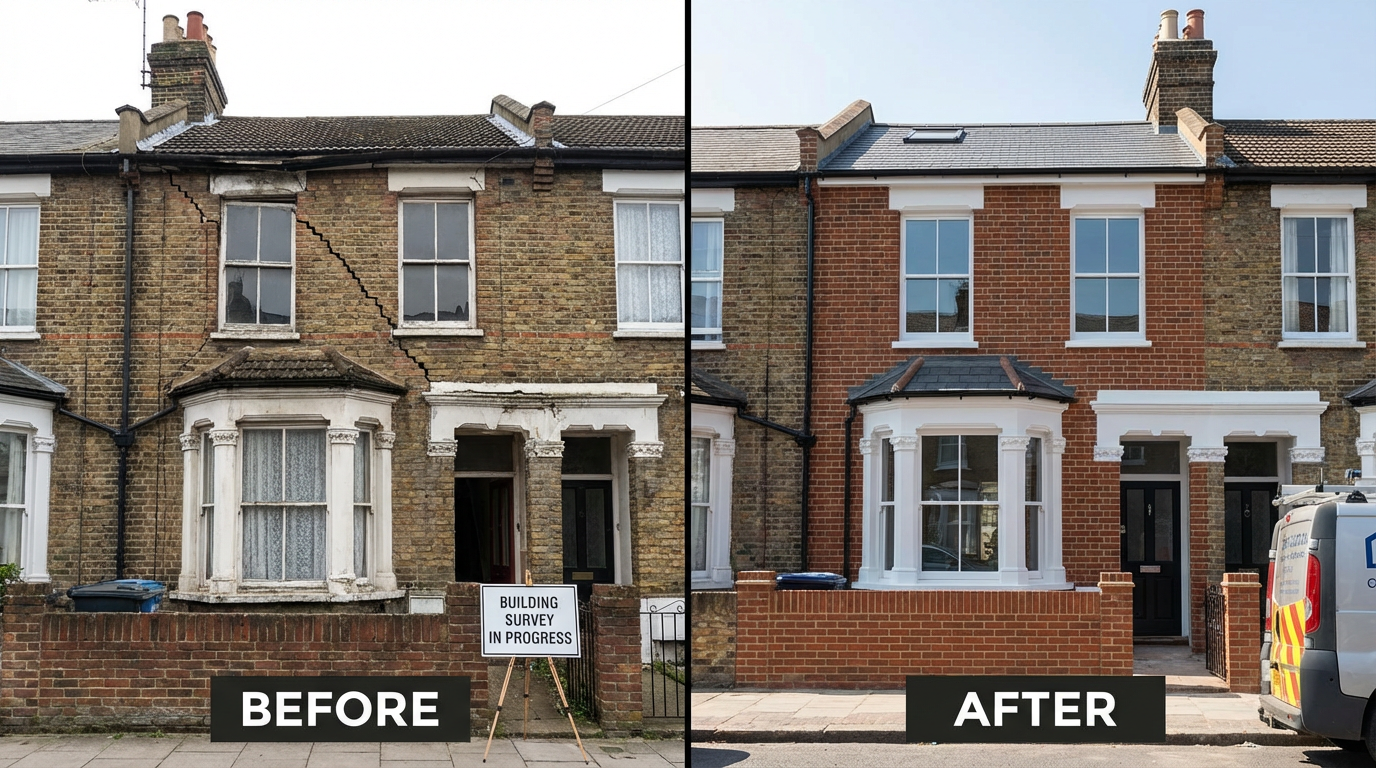
Every week, I carry out building surveys on London properties and discover things that neither the buyer, the vendor nor the estate agent had any idea about. Some findings are minor — a missing roof tile, a dripping gutter, a damp patch that hasn't been treated. Others change the entire transaction. After 20 years as a building surveyor in Paddington, I've learned that almost no property in London is entirely problem-free. The question is whether you know what you're getting into.
This article is my honest account of what a Level 3 Building Survey actually uncovers — based on real cases from my years working across W2, W11, W8 and the wider London area.
What Is a Level 3 Building Survey?
The Level 3 Building Survey (formerly called a Full Structural Survey) is the most comprehensive property survey available in the UK. Unlike a mortgage valuation — which simply confirms whether a lender's security is adequate — a building survey is a detailed investigation of the physical condition of a property.
I inspect everything I can access: the roof structure, walls, floors, ceilings, windows, drainage, outbuildings, services and grounds. I use moisture meters, a borescope camera where needed, and I now also carry a thermal imaging camera on every inspection. The resulting report runs to 40–80 pages for a typical Victorian terraced house, with photographs of every significant finding.
The Top 8 Things Building Surveys Uncover
1. Damp — in its Many Guises
Damp is the single most common finding in London building surveys. But not all damp is the same, and identifying the type correctly is crucial — because the wrong treatment can actually make things worse.
Rising damp occurs when moisture travels upward through porous masonry from the ground. It's common in Victorian properties where the original slate damp-proof course has broken down or been bridged by raised soil or paving. Penetrating damp comes from water finding a route through the external fabric — a cracked render, a leaking gutter, a missing pointing. Condensation damp, the most common of all, is caused by warm moist air meeting a cold surface and has nothing to do with the building fabric at all.
I've seen properties where the vendor had paid thousands of pounds for a chemical damp-proof course injection — a treatment that was completely unnecessary because the issue was condensation, not rising damp. A good building survey identifies the type and, crucially, the cause.
2. Dry Rot — the Property Market's Dirty Secret
Dry rot (Serpula lacrymans) is every homeowner's nightmare — and one of the most expensive building defects there is. In its advanced stages, it can spread through walls, beneath floors and behind plaster, colonising timber and masonry across a large area before any visible signs appear at the surface.
I once surveyed a terraced house in Notting Hill where the vendor had recently had the kitchen refitted. Beautiful job, lovely quartz worktops, new flooring. Behind the units, hidden from view, was a significant dry rot outbreak affecting the timber frame of the rear extension. The buyer used my report to negotiate £22,000 off the asking price.
Dry rot loves the damp, unventilated voids typical of Victorian London houses — beneath kitchen extensions, behind bath panels, under ground floor suspended timber floors. I always lift inspection hatches if they're there, and insist on accessing sub-floor voids even if the vendor or agent is reluctant.
3. Structural Movement — Understanding the Difference Between Cosmetic and Serious
London sits on a thick layer of London Clay, a soil that swells significantly when wet and shrinks dramatically during dry summers. The result is that almost every London Victorian terrace has some degree of structural movement — the question is always whether it's historic (finished) or progressive (ongoing).
Diagonal cracks running from window and door corners are classic indicators of differential settlement. Stepped cracks following mortar lines in the brickwork often indicate soil movement. Horizontal cracks near the top of a basement wall may suggest lateral soil pressure.
I spend considerable time assessing cracks during every survey — measuring width, checking whether they've been previously repaired, looking for patterns that indicate the cause. The key question I'm always asking is: is this building still moving? If yes, why?
4. Roof Defects — Hidden at Altitude
Victorian terraced houses in Paddington and Bayswater typically have pitched slate or clay tile roofs with lead flashing at the valleys and abutments. After 100+ years, slates crack, nails rust and lead work corrodes. Repointing the ridge tiles in lime mortar is a job that needs doing every 30–40 years. Many roofs I survey haven't been touched in decades.
The most common roof finding I report is failed or missing lead flashing — the metal strips that seal the junction between the roof slope and chimney stacks, dormer walls and parapet walls. A failed flashing allows water ingress that can saturate wall plates and rafters, causing rot that's invisible from inside the property until the ceiling collapses.
5. Chimney Stack Problems
London's Victorian terraces bristle with chimney stacks, and most of them are in varying states of disrepair. Cracked flaunching (the cement mortar that holds the pots), missing pots, crumbling brickwork and failed lime mortar pointing are all common. More seriously, a partially collapsed flue can allow carbon monoxide to enter a room if a gas fire or woodburner is in use.
6. Services: the Invisible Risk
Building surveys are not a full services inspection — we don't pressure-test gas pipes or CCTV-survey drains as a matter of routine. But we do give the services a visual assessment, and regularly identify concerns that warrant specialist investigation. Old lead pipework, unsleeved gas pipes passing through walls, outdated fuse boards with ceramic fuses rather than MCBs, asbestos cement flue pipes — all of these flag the need for further investigation before exchange.
7. Basement Issues
In London's most desirable areas, basement conversions have become extremely common. A well-designed and properly constructed basement is a valuable addition; a poorly built one is a source of ongoing misery. I check waterproofing systems, inspect the junction between the basement and ground floor structure, and look for signs of water ingress that indicate the tanking has failed.
8. Party Wall and Boundary Issues
During a building survey, I often notice evidence of work that appears to have been carried out without the proper party wall authorisation — walls that have been cut into, beams inserted through party walls, or foundations excavated close to the boundary. While the survey itself can't determine whether the Party Wall Act was complied with, I flag these observations so clients can ask the solicitor to investigate further. See our complete guide to party wall agreements.
A Real Case Study: Paddington W2, 2024
I'll end with a real example from a survey I carried out last year — with the client's permission, though the address remains confidential. A couple were buying a Victorian end-of-terrace in W2 for £1.4 million. They'd had an offer accepted, instructed solicitors, and were feeling positive about the purchase.
During my inspection, I found:
- Active rising damp to a depth of 900mm on the front and rear walls of the ground floor
- Significant dry rot outbreak beneath the kitchen floor, affecting approximately 6m² of timber
- Cracks consistent with subsidence on the flank wall — likely caused by a mature London plane tree in the pavement outside
- Failed lead flashing to both chimney stacks
- An old consumer unit that the electrical specialist I recommended subsequently condemned
The total estimated remediation cost came to between £48,000 and £65,000. My clients used the report to negotiate a £40,000 reduction in the purchase price. They completed, carried out the works and are now very happy in their Paddington home.
"People sometimes ask me whether it's worth paying for a full building survey. I always give the same answer: it cost you £800 to potentially save you £40,000. What else in life gives you that return?"
How to Use Your Building Survey
A building survey is most valuable when you read it alongside your surveyor. At Paddington Surveyors, we always call clients the moment we've issued the report to walk through the key findings. We explain what's urgent, what to monitor and what you can safely leave. We can also provide estimated costs for repairs within the report or as an addendum, which you can use directly in your price negotiation.
The goal is simple: you should finish reading your survey with a clear sense of what you're buying, what it's going to cost you, and whether the price you've agreed reflects the property's true condition. That's what a good Level 3 Building Survey delivers.