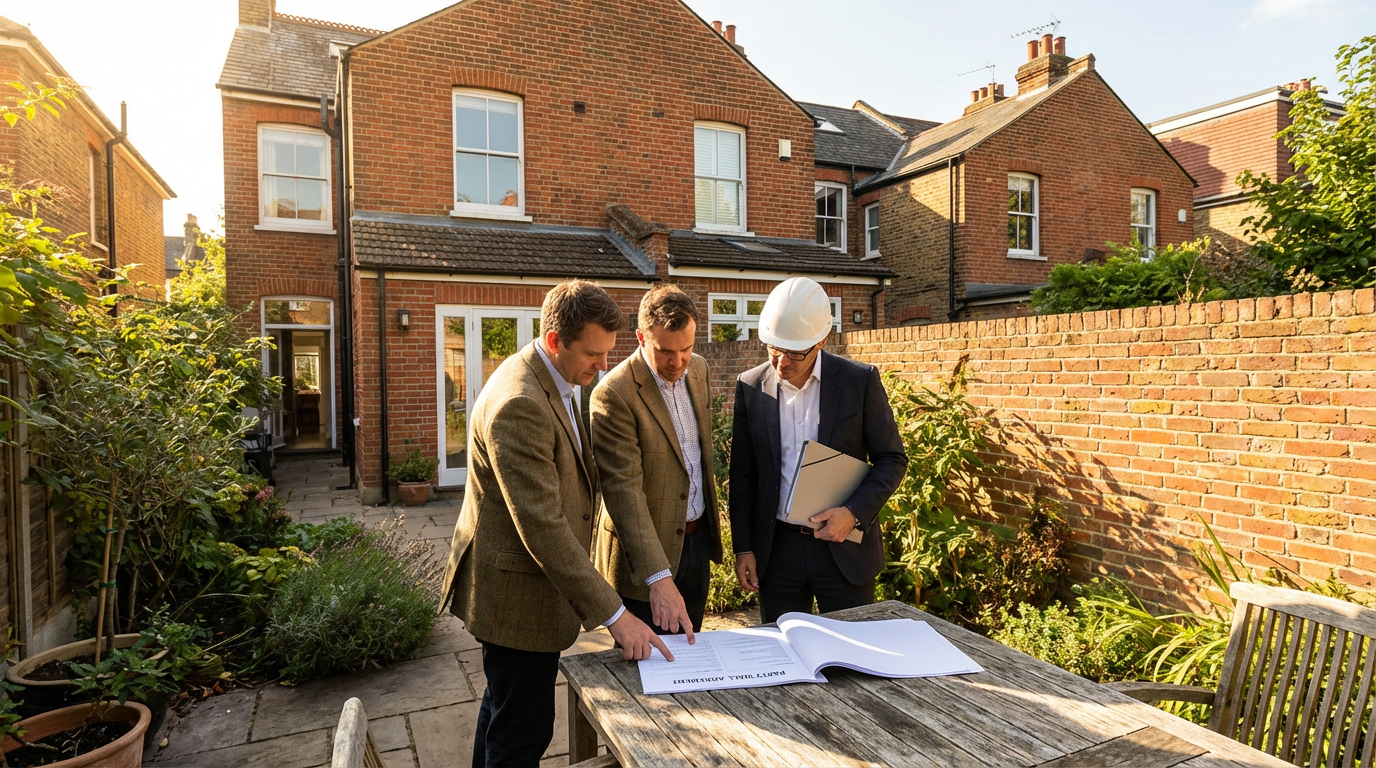
Party walls come up in almost every London extension, loft conversion and basement project — yet they remain one of the most misunderstood aspects of building law. I've been handling party wall matters for Paddington Surveyors since 2017, and I still receive enquiries from homeowners who've already started building work without serving notice, or who've served notice incorrectly and are now facing an injunction.
This guide covers everything you need to know about party wall agreements in plain English — from what triggers the Party Wall etc. Act 1996 to what happens when your neighbours appoint their own surveyor.
What Is the Party Wall etc. Act 1996?
The Party Wall etc. Act 1996 is UK legislation that provides a framework for preventing and resolving disputes in relation to party walls, boundary walls and excavations near neighbouring buildings. It applies in England and Wales.
The Act requires building owners to notify their neighbours (called "adjoining owners" in the Act) before they carry out certain types of work. It doesn't prevent you from carrying out work — it simply ensures your neighbours are notified and have the opportunity to protect their interests. Most party wall matters resolve amicably and the Act rarely leads to lengthy disputes.
What Work Triggers the Party Wall Act?
Three types of work trigger the Party Wall Act:
- Work on a party wall or structure (Section 2 Notice): This includes cutting into a party wall to insert beams, raising or extending a party wall, underpinning, weatherproofing, and demolishing and rebuilding a party wall. It also covers notching or cutting into a party wall to bear a floor.
- Building a new wall on or at the boundary line (Section 1 Notice): If you want to build a wall astride the line of junction (on the boundary) or entirely on your own land within 3 metres of the boundary, you must serve notice.
- Excavating within 3 or 6 metres of a neighbouring structure (Section 6 Notice): This catches most basement extensions and deep foundation works. If you're digging within 3 metres of a neighbour's building to a depth greater than their foundations, or within 6 metres if the excavation meets a particular depth/angle test, a Section 6 Notice is required.
The Party Wall Process: Step by Step
Step 1 – Serve Notice
The first step is to serve a formal written Party Wall Notice on your adjoining owner(s). Notices must be served at least one month before work begins for Section 2 works, and at least two months before work begins for Section 6 excavation works. The notice must describe the proposed works, specify the start date and include a copy of the relevant section of the Act.
Many homeowners serve their own notices to save costs, which is fine for straightforward situations. However, if the notices aren't served correctly — with incomplete descriptions, wrong notice periods or served on the wrong person — they won't be valid, and the clock won't start ticking.
Step 2 – Adjoining Owner Responds
After receiving notice, the adjoining owner has 14 days to respond. They can:
- Consent in writing — work can proceed. No surveyor needed.
- Dissent and agree to a single agreed surveyor — both parties jointly appoint one surveyor to prepare the Award.
- Dissent and appoint their own surveyor — each party appoints their own surveyor, who together appoint a third surveyor to resolve any disputes between them.
- Fail to respond within 14 days — this is treated as a dissent and a dispute is deemed to have arisen.
Step 3 – Schedule of Condition
Before works commence, the party wall surveyor(s) will usually prepare a Schedule of Condition — a detailed photographic and written record of the condition of the adjoining property at the time work starts. This is vital because it provides a baseline against which any damage claims during construction can be assessed. It protects both parties.
Step 4 – The Party Wall Award
The Party Wall Award (sometimes called a "determination") is the legal document that governs the works. It describes the nature of the work, the methodology to be used, working hours, how any damage is to be remedied and how the costs of the Award are to be met.
In most cases, the building owner pays all the costs of the party wall process, including the adjoining owner's reasonable surveyor's fees. This is because the building owner is causing the disturbance.
What Happens If My Neighbour Won't Agree?
A common misconception is that a difficult neighbour can block your building works entirely. They can't. The Party Wall Act gives them the right to be notified and to have their interests protected, but not to veto works that are otherwise lawful. If a dispute arises, the surveyor(s) will resolve it in the Award, which is a legally binding document.
What your neighbour can do is appoint their own surveyor, which extends the process and increases costs. They can also seek an injunction if works proceed without a valid Award being in place. This is why getting the process right from the start is so important.
Common Party Wall Mistakes to Avoid
- Starting work before an Award is agreed: This is the most serious mistake. Without a valid Award, the building owner has no protection against claims and can face an injunction stopping all work.
- Not serving notice on all affected adjoining owners: In a terrace, you may need to notify both immediate neighbours and potentially an upstairs flat above you.
- Serving notice too late: Many builders want to start work immediately. A minimum one or two-month notice period is non-negotiable.
- Using the same surveyor for complex disputes: A single agreed surveyor is perfectly fine for amicable situations, but if there's genuine disagreement about the impact of the works, each party should have independent representation.
How Much Does a Party Wall Agreement Cost?
Surveyor fees for party wall work in London typically range from £700–£1,500 per adjoining owner for a straightforward loft conversion or rear extension, rising to £2,000–£4,000+ per owner for complex basement projects or multi-unit blocks. As the building owner, you'll pay your own surveyor's fees plus the reasonable fees of your neighbours' surveyors.
The cost of getting it wrong is far higher. Injunction proceedings, construction delays and contractor standing-time costs can run to tens of thousands of pounds.
Case Study: Bayswater Loft Conversion, 2024
Last year, I was appointed as the Adjoining Owner's Surveyor on a loft conversion project in Bayswater. The building owner had served notice — correctly — on both neighbours. One consented; the other dissented and appointed me.
My role was to protect my client's interests while facilitating the building owner's legitimate works. I reviewed the structural drawings, requested additional information on the method of fixing steel beams into the party wall, and negotiated a revised methodology that reduced the vibration transfer during installation. The Award was agreed within six weeks of my appointment and the works proceeded without incident. My client's surveyor fees were paid by the building owner — as is standard under the Act.
For more advice on party wall matters, see our party wall services page or get in touch.