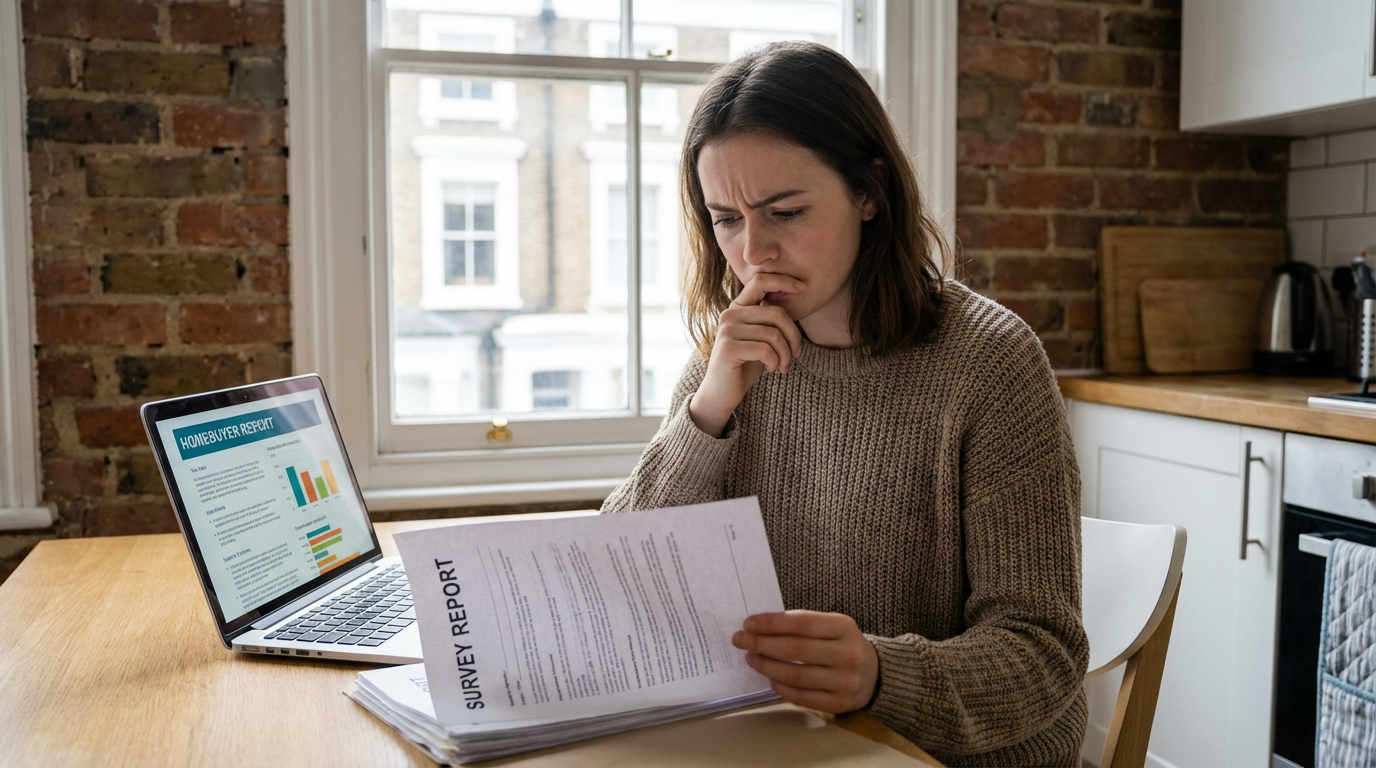
You've had an offer accepted on your first property and your solicitor has recommended getting a survey. You've Googled "RICS Homebuyer Report" and found yourself overwhelmed by Level 1, Level 2, traffic lights, condition ratings and market valuations. I hear this from first-time buyers every week. So let me cut through the jargon and tell you exactly what a Homebuyer Report is, what it covers, and what to do when you get it.
What Is an RICS Homebuyer Report?
The RICS Homebuyer Report is a standardised property survey produced under the RICS Home Survey Standard. It sits at Level 2 in the RICS suite of surveys — more detailed than a Level 1 Condition Report but less detailed than a Level 3 Building Survey.
The report uses a standardised format and a traffic-light condition rating system to assess the main elements of a property. It's designed to be clear and accessible — you shouldn't need a surveying qualification to read it.
The Level 2 Homebuyer Report is the most popular survey in the UK, and for the right property, it's an excellent product. But it's not right for every property — and choosing the wrong survey type is one of the most common mistakes property buyers make. Read our comparison of survey levels on our services page.
The Traffic Light Condition Ratings Explained
The RICS condition rating system uses three colours to indicate the urgency and severity of issues found during the inspection:
The element is in a satisfactory condition. There are no current problems. Standard maintenance may be required.
There are defects present that may develop into more serious problems if left unattended. These are not urgent but require attention. A specialist may be needed.
There are serious defects that are significant, or have a high risk of failure, and require immediate attention before or shortly after purchase.
What Does a Homebuyer Report Actually Inspect?
The surveyor carries out a visual inspection of all accessible parts of the property. For a typical London flat or modern house, this typically includes:
- External walls, roof covering and roof structure (from ground level or a loft hatch)
- Windows, doors, gutters and downpipes
- Internal walls, ceilings and floors
- Kitchen and bathroom fittings (visual check only — not a drains test)
- Services including heating, plumbing and electrical (visual check — not a full test)
- Grounds including paths, boundaries and drainage
Importantly, a Level 2 survey does not normally include access to the roof space — your surveyor will look through the hatch but won't normally go in. This is one reason why older properties with potential roof structure issues warrant a Level 3 survey instead.
Does It Include a Valuation?
The standard RICS Homebuyer Report includes a market valuation — an opinion of the property's open market value at the date of inspection. This is useful but should not be confused with a mortgage valuation (which is carried out for the lender, not for you). The Homebuyer Report valuation is your surveyor's professional opinion of what the property is worth in its current condition.
Some clients use the valuation to challenge an agreed purchase price if the surveyor's figure is lower. This can be a legitimate basis for renegotiation — see our guide to using your survey to renegotiate the price.
What to Do When You Receive Your Report
The first thing to do is not to panic. Even a well-maintained modern flat will have some Condition 2 ratings — these are genuinely common and don't mean the property is in poor condition. They typically reflect normal wear and tear items like minor repointing, gutters that need clearing, or a slightly tired bathroom sealant.
The items that deserve your full attention are any Condition 3 ratings. For each of these, ask your surveyor:
- What is the defect, in plain English?
- What is the likely cause?
- What specialist investigation is needed?
- What is a realistic estimate of the repair cost?
At Paddington Surveyors, we always call clients after delivering a report to walk through every Condition 3 finding. We know from experience that reading a report alone, late at night, without anyone to explain it, can send first-time buyers into a completely unnecessary panic.
Should I Get a Level 2 or Level 3 Survey?
This is the question I get asked most often, and the answer depends on the property. As a general rule:
- Level 2 Homebuyer Report is appropriate for: modern flats (post-1950), purpose-built blocks in good condition, properties that have been comprehensively renovated recently.
- Level 3 Building Survey is appropriate for: Victorian and Edwardian houses (pre-1919), properties that have been extended or altered, any property where you have specific concerns about structural condition or damp.
If in doubt, upgrade to a Level 3. The extra cost is modest compared to the risk of missing a significant defect on an older property.
"I've never had a client regret spending the extra money on a Level 3 survey. I've had plenty who regretted not doing so."