Damp is the word that strikes fear into most property buyers — and rightly so, given that it's the most common significant finding in London building surveys. But damp isn't a single thing. It's an umbrella term for several distinct moisture-related conditions, each with different causes, different diagnostic approaches and radically different treatments. Getting the diagnosis wrong and applying the wrong treatment is expensive, ineffective and, in some cases, actively harmful to the building fabric.
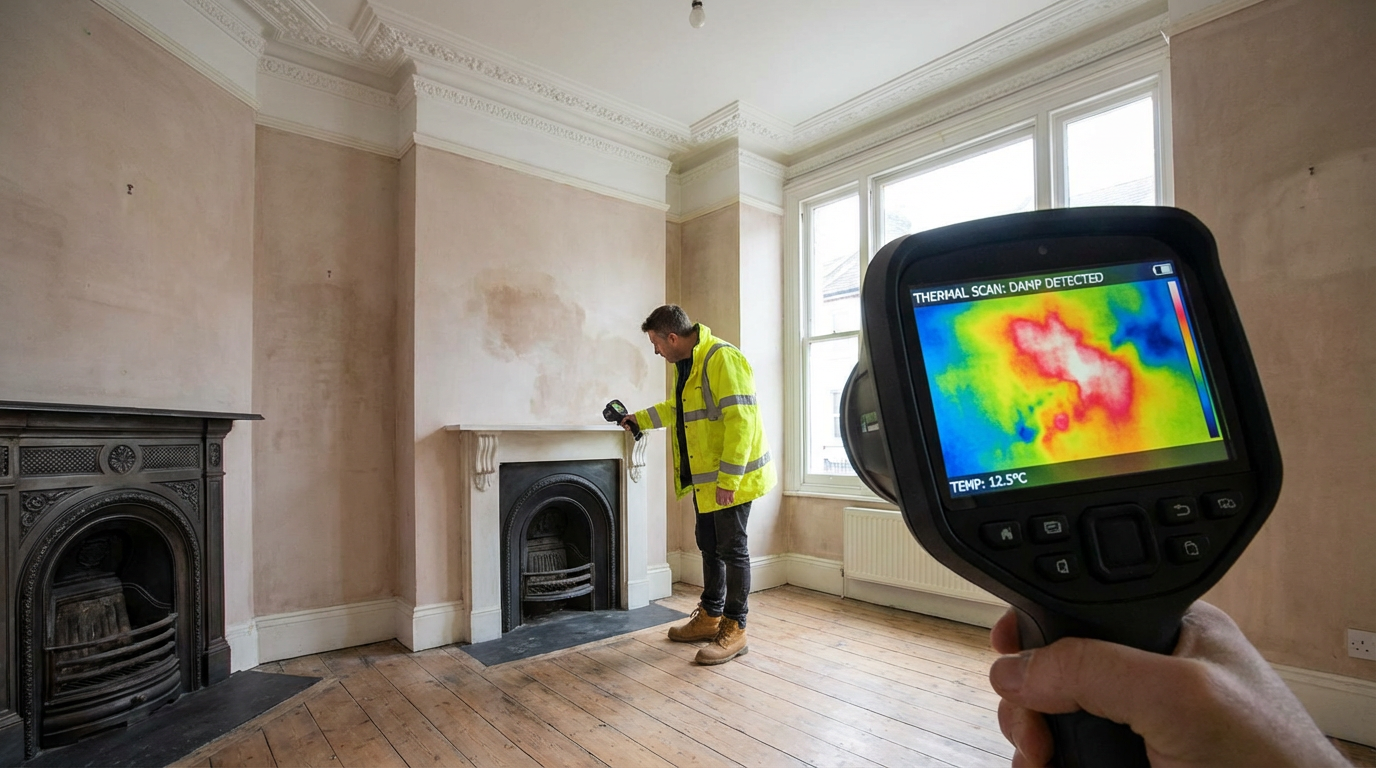
I've been using thermal imaging cameras in my surveys for three years now, and the technology has been a revelation. I regularly find moisture that's completely invisible to the naked eye — water tracking behind plasterwork, saturating joist ends, sitting in voids beneath kitchen units. In this article, I'll explain the main types of damp you'll encounter in London properties, how I diagnose them, and what good remediation actually looks like.
The Three Main Types of Damp in London Properties
1. Rising Damp
Rising damp is caused by groundwater being drawn up through the capillary pores in masonry. It's typically characterised by a distinct "tide mark" on internal walls, usually no higher than about 1–1.2 metres above floor level, with plaster staining, salt crystallisation (efflorescence) and sometimes peeling paint or wallpaper.
True rising damp requires a missing, damaged or bridged damp-proof course (DPC). Victorian properties were typically built with a thin layer of slate or bitumen felt as the DPC, which can deteriorate over time. However — and this is critical — the DPC is frequently bridged by external soil that has built up above the DPC level, by render that has been applied down past the DPC, or by internal floor screed that covers the DPC.
The correct treatment for bridged DPC is to remove the bridging: lower the external ground level, strip render below DPC level, or re-lay the floor screed. Chemical DPC injection is usually only needed when the original DPC has genuinely failed — and even then, it needs to be combined with replastering using a renovating plaster mix that tolerates residual salts.
2. Penetrating Damp
Penetrating damp occurs when water finds a route through the external fabric of the building and enters the wall, floor or roof structure. Unlike rising damp, it can occur at any height and often has a clear relationship with weather conditions — damp patches appear or worsen after heavy rain and dry out in dry periods.
Common causes in London Victorian properties include:
- Failed or missing lead flashing at chimney abutments and parapet walls
- Cracked or spalling external render that holds water rather than shedding it
- Missing or cracked pointing in brick or stonework
- Blocked or overflowing gutters and downpipes allowing water to saturate the wall face
- Failed window or door sills with cracked or missing sealant
- Flat roof coverings that have reached the end of their service life
Treatment involves identifying and repairing the specific route of water ingress. This is often more straightforward and less expensive than dealing with rising damp — but it requires accurately identifying the source, which thermal imaging makes much easier.
3. Condensation Damp
Condensation is, by a considerable margin, the most common moisture problem in London residential properties — particularly in flats, basements and properties with poor ventilation. It occurs when warm, moisture-laden air meets a cold surface and the moisture condenses.
Classic signs include mould growth (typically black mould) at wall-to-ceiling junctions and in the corners of rooms, particularly bedrooms and bathrooms. The moisture meter readings associated with condensation are superficial — the wall itself is not deeply saturated, only its surface.
The cause is almost always a combination of lifestyle (cooking, showering, drying clothes indoors) and inadequate ventilation. The fix is improving ventilation and sometimes improving the thermal performance of cold surfaces (additional insulation to cold walls). Treating condensation with anti-fungal paint and chemical DPC injection achieves nothing.
How I Diagnose Damp: The Thermal Imaging Approach
Traditional damp diagnosis relies heavily on surface moisture meter readings. The problem is that these meters can be fooled by salt deposits, foil-backed wallpaper and other non-moisture factors. I now use thermal imaging cameras in every Level 3 survey to identify cold spots, damp patches and thermal bridges that are invisible in normal light.
Thermal imaging is most effective early in the morning or in cold weather, when there's a significant temperature differential between inside and outside. A damp wall will appear cooler than a dry wall at the same location because water has a high thermal mass. This allows me to identify moisture patterns that reveal whether the issue is rising (appearing from the bottom of walls), penetrating (concentrated in a specific area with a clear relationship to external elements) or condensation-related (typically affecting corner zones or areas of thermal bridging).
A Real Case Study: Paddington Basement Flat
Last year I surveyed a basement flat in a Victorian terrace in Paddington W2. The vendor had recently paid £3,200 for a chemical DPC treatment and had replastered the ground floor rooms. The property looked immaculate.
My thermal imaging camera told a different story. Behind the newly plastered party wall on the right-hand side, I could see a clear vertical cold stripe extending from floor to ceiling, becoming more intense at the base. There was also a cool zone at the left rear corner of the main bedroom that was clearly unrelated to ground moisture.
My diagnosis: the cold stripe was penetrating damp caused by a failed lead flashing on the neighbouring property's side return extension — the DPC treatment had been irrelevant. The rear corner was condensation caused by a thermal bridge at the junction of the subfloor void and the external wall.
The buyer used this report to negotiate a £12,000 reduction in the price, and the penetrating damp was remedied — correctly this time — by replacing the lead flashing.
The "Damp Survey" Industry: Buyer Beware
One important note: be very cautious about "damp surveys" carried out by damp treatment companies. These companies — which sell chemical DPC injections, tanking systems and other treatments — have a commercial interest in finding damp problems and prescribing expensive solutions. Many reputable studies, including research published in the Structural Survey journal, have found that chemical DPC injection is frequently unnecessary and sometimes counterproductive.
An independent surveyor — with no financial interest in any particular treatment — is always the right starting point for a damp diagnosis. See our structural survey and defect investigation services for more information.