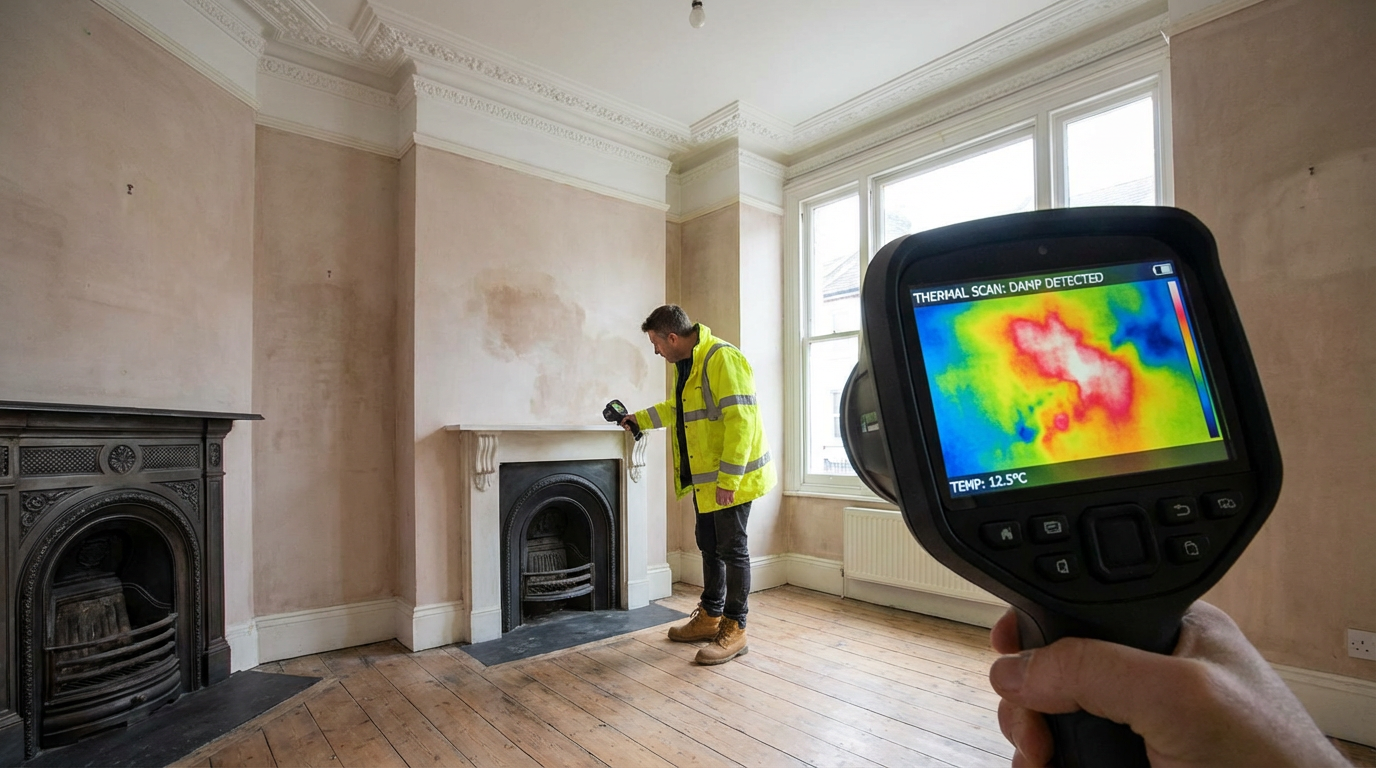
The pressure to improve a home's energy performance has never been greater. Rising energy bills, incoming EPC legislation for landlords and growing environmental awareness mean more London homeowners are considering retrofit works than at any point in the past twenty years. But in a city dominated by Victorian and Edwardian stock — solid brick walls, suspended timber floors, single-pane sash windows — the risks of getting retrofit wrong are significant. Before you spend a single pound on insulation or heat pumps, here's what a building surveyor needs you to know.
What Is an Energy Performance Certificate (EPC)?
An EPC rates a property's energy efficiency on a scale from A (most efficient) to G (least efficient). It's produced by a Domestic Energy Assessor (DEA) and is a legal requirement for properties being sold or let. The rating is based on a standardised modelling methodology called RdSAP, which estimates energy use based on the property type, construction, heating system and insulation.
It's important to understand what an EPC is not: it is not a building survey. An EPC assessor does not inspect for defects, identify building pathologies or assess the suitability of a property for retrofit works. That is where a building surveyor's assessment becomes essential.
The Retrofit Risk in Older London Properties
Victorian and Edwardian houses were designed to breathe. Their solid brick walls, lime mortar joints and suspended timber floors all allow moisture to move through the fabric and evaporate. This is entirely intentional — it's how these buildings have survived for over a century in London's wet climate.
Modern insulation materials, particularly vapour barriers and closed-cell spray foam, can disrupt this moisture movement. If warm, moist internal air can no longer pass through the building fabric and escape, it condenses at the cold interface between old and new materials. The result can be devastating: interstitial condensation leading to mould growth, timber rot and even structural damage — all hidden behind a newly insulated wall.
The Cavity Wall Insulation Problem
Cavity wall insulation (CWI) is one of the most promoted retrofit measures in the UK. For post-1920s cavity-wall construction in a sheltered location, it can be very effective. For Victorian solid brick terraces — which have no cavity — it is simply not applicable. And even for genuine cavity-wall properties in exposed London locations, poorly installed CWI has caused widespread damp problems.
I have surveyed multiple properties in W2 and W9 where cavity wall insulation installed under government grant schemes has resulted in persistent penetrating damp to internal walls. The insulation itself became saturated, bridging the cavity and allowing water to track inward. Remediation — removing the insulation and allowing the wall to dry out — can cost thousands of pounds and take months.
Before any cavity wall insulation is considered, a building surveyor should assess whether the existing cavity is clear and dry, the external render and pointing are sound, and the location is not exposed to driving rain.
Spray Foam Insulation in Roof Spaces
Spray polyurethane foam (SPF) applied to the underside of roof rafters has become one of the most contentious issues in the property market. It was widely promoted as an energy-saving measure, but many mortgage lenders now refuse to lend against properties where spray foam has been applied to the roof structure — because it bonds to the timbers and prevents inspection of the structural members beneath.
If you are buying a property with spray foam insulation in the roof space, your building surveyor cannot properly assess the condition of the roof timbers. I always flag this as a significant limitation in my reports and recommend specialist investigation before exchange. If you are considering applying spray foam insulation, my strong advice is: don't.
What a Retrofit Assessment Involves
A proper retrofit assessment — as opposed to a basic EPC — should include:
- Identification of the construction type and materials of all elements (walls, roof, floors, windows)
- Assessment of existing moisture conditions using moisture meters and thermal imaging
- Identification of existing ventilation pathways and their adequacy
- Review of any previous works that may have altered the building's moisture management
- Recommendations for retrofit measures that are compatible with the building's construction
- Sequencing advice — which measures should be done first to avoid creating problems
At Paddington Surveyors, we carry thermal imaging cameras on all inspections. Thermal imaging can identify cold bridges, missing insulation in existing installations, air leakage paths and heat loss patterns that are invisible to the naked eye — and which a standard EPC assessment will never detect.
Heat Pumps in Victorian Houses: The Honest Assessment
Air source heat pumps (ASHPs) are increasingly promoted as the successor to gas boilers, and for many properties they can work very well. But they are fundamentally different to gas boilers in one important respect: they operate most efficiently at lower flow temperatures, typically 35–45°C, compared to the 60–70°C of a conventional gas system.
This means that for a heat pump to work effectively, the property must be well enough insulated that relatively low-temperature heat from large-surface-area emitters (underfloor heating or oversized radiators) is sufficient to maintain a comfortable temperature in cold weather. For a poorly insulated Victorian terrace with original single-glazed sash windows, this is a significant challenge.
This does not mean heat pumps cannot work in older London properties — I have seen them installed very successfully. But it does mean that a thorough assessment of the building fabric should precede any heat pump installation, and that expectations about running costs need to be realistic.
Practical Steps Before Any Retrofit Work
- Commission a building survey first. Understand what you have before you start. Defects in the existing fabric — cracked render, failed pointing, blocked gutters — will undermine any retrofit works if left unaddressed.
- Get a proper retrofit assessment, not just an EPC. An EPC tells you how the building performs in theory. A retrofit assessment tells you what works are suitable and in what order.
- Start with the fabric, not the services. Draught-proofing, secondary glazing for sash windows, loft insulation (where appropriate) and addressing ventilation are lower-risk interventions than cavity fill or heat pumps.
- Be cautious with cavity wall insulation. Get professional advice on whether your cavity is suitable, and use only reputable installers who carry out a pre-installation inspection.
- Avoid spray foam insulation in roof spaces. The mortgage lender risk alone makes this a measure to avoid, regardless of its thermal properties.
Summary
Improving the energy efficiency of a London home is entirely achievable — but it needs to be done in a way that respects how older buildings work. A building surveyor's assessment before any retrofit works is not an optional extra: it is the foundation on which good retrofit decisions are made. Done correctly, energy improvements will reduce bills, improve comfort and add value. Done incorrectly, they can cause expensive and difficult-to-remedy building defects.
If you would like a thermal imaging survey or pre-retrofit building assessment on your London property, contact our team for a free quote.