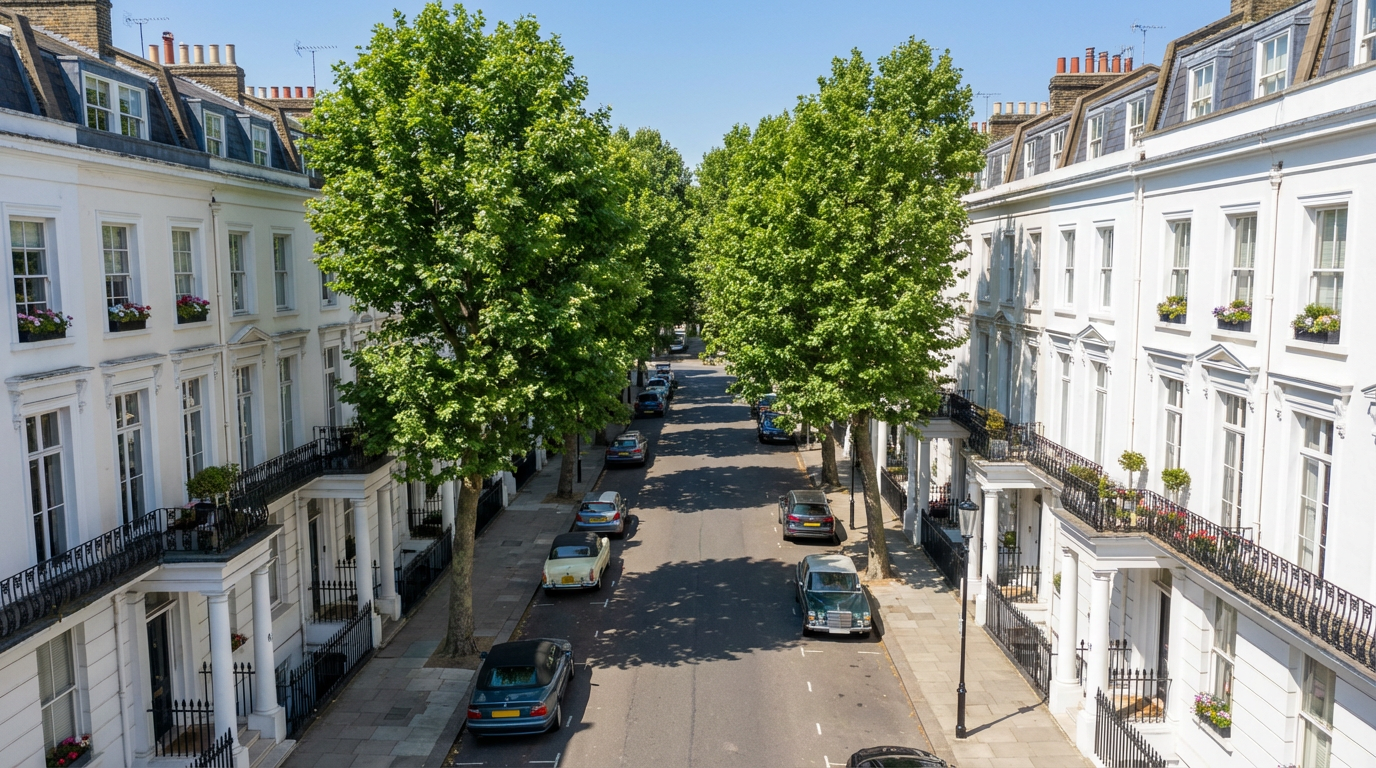
Paddington has been my professional home for over 20 years. I know every street, every terrace type, most of the common issues you'll encounter in W2, and the subtle ways in which different parts of Paddington differ from each other. I've watched the property market here evolve dramatically — from the Crossrail effect to the pandemic-era flight to space and the recent interest rate cycle. This is my current assessment of where things stand in 2025.
The Paddington Property Market in 2025
Paddington (W2) remains one of Central London's most distinctive and resilient property markets. The combination of excellent transport links — Paddington Station provides access to Heathrow, the Elizabeth line, the Great Western Main Line and five underground lines — with attractive period housing stock and proximity to Hyde Park continues to attract a wide range of buyers.
Average flat prices in W2 currently sit at around £700,000–£950,000 for a one-bedroom flat and £1.1m–£1.8m for a two-bedroom flat, depending on the specific location and specification. Victorian terraced houses command £1.8m–£3.5m+, with the finest stucco-fronted townhouses on premium streets like Westbourne Terrace and Sussex Square reaching well into the £4–6 million range.
The Different Characters of Paddington
Paddington is not a monolithic neighbourhood — it contains several distinct micro-areas with quite different characteristics and buyer profiles.
Bayswater (south): The area south of Bayswater Road and north of Notting Hill Gate is dominated by grand white stucco terraces of the mid-Victorian era. These are frequently converted into flats, and the leasehold structure of many buildings in this area deserves careful attention. Values are strong and there is consistent demand from international buyers.
Little Venice: The canal-side area around the confluence of the Grand Union Canal and Regent's Canal is one of London's most charming locations. Properties here include generous Victorian villas, attractive mansion blocks and — uniquely — permanently moored houseboats. Surveying houseboats requires specialist marine surveyors rather than building surveyors.
Maida Vale: Immediately north of Little Venice, Maida Vale has wide, tree-lined avenues and handsome mansion blocks. It attracts a different demographic from Bayswater — typically families and professionals who value space and tranquility over proximity to tourist hotspots. Values are slightly lower per square foot than prime Bayswater.
Paddington Basin: The regeneration area around the basin has produced a cluster of modern, high-specification apartments and commercial buildings. These are very different in character and condition from the surrounding Victorian stock — newer builds have different survey considerations, with building safety and defect liability under the Building Safety Act 2022 being increasingly relevant.
What I See in Surveys Across Paddington in 2025
From a surveying perspective, several themes emerge consistently from my work across W2 in 2025:
Quality of renovation work: The post-pandemic renovation boom produced a lot of quickly-done, cosmetically appealing but structurally questionable work. I see properties that have been beautifully presented but which conceal poorly done structural work, inadequate damp treatment and services that haven't been properly upgraded. The best-presented properties are not always the safest to buy.
Basement conversions: The basement conversion trend in Paddington reached its peak around 2018–2020 and many of those conversions are now showing signs of waterproofing issues. I'm seeing an increasing number of survey instructions for properties with basement suites where tanking has failed and water ingress has begun.
Energy efficiency expectations: Buyers in 2025 are increasingly aware of EPC ratings and energy costs. Victorian properties inherently perform poorly on energy metrics — solid brick walls with no cavity insulation, single-glazed sash windows, uninsulated suspended floors. I'm seeing more survey clients asking for detailed commentary on the scope for energy improvement works and the costs involved.
Party wall legacy issues: The large number of loft conversions and extensions carried out in Paddington over the past decade means that many properties I survey carry legacy party wall issues — evidence of works that were done without proper Awards, poorly documented Schedule of Conditions, or disputes that were never properly resolved. This can create issues for future sales.
My Advice for Paddington Buyers in 2025
Always commission a Level 3 Building Survey for any Victorian property in W2, W9 or W11. The property values are too high and the building stock too complex for anything less. Use your survey findings to negotiate — the market in 2025 is more balanced than it was in 2021–2022, and vendors are generally more willing to accept price adjustments for genuine defects. And if you're planning any works after purchase, start thinking about party wall obligations early.
As always, the team at Paddington Surveyors is available to advise on any property you're considering in the area.