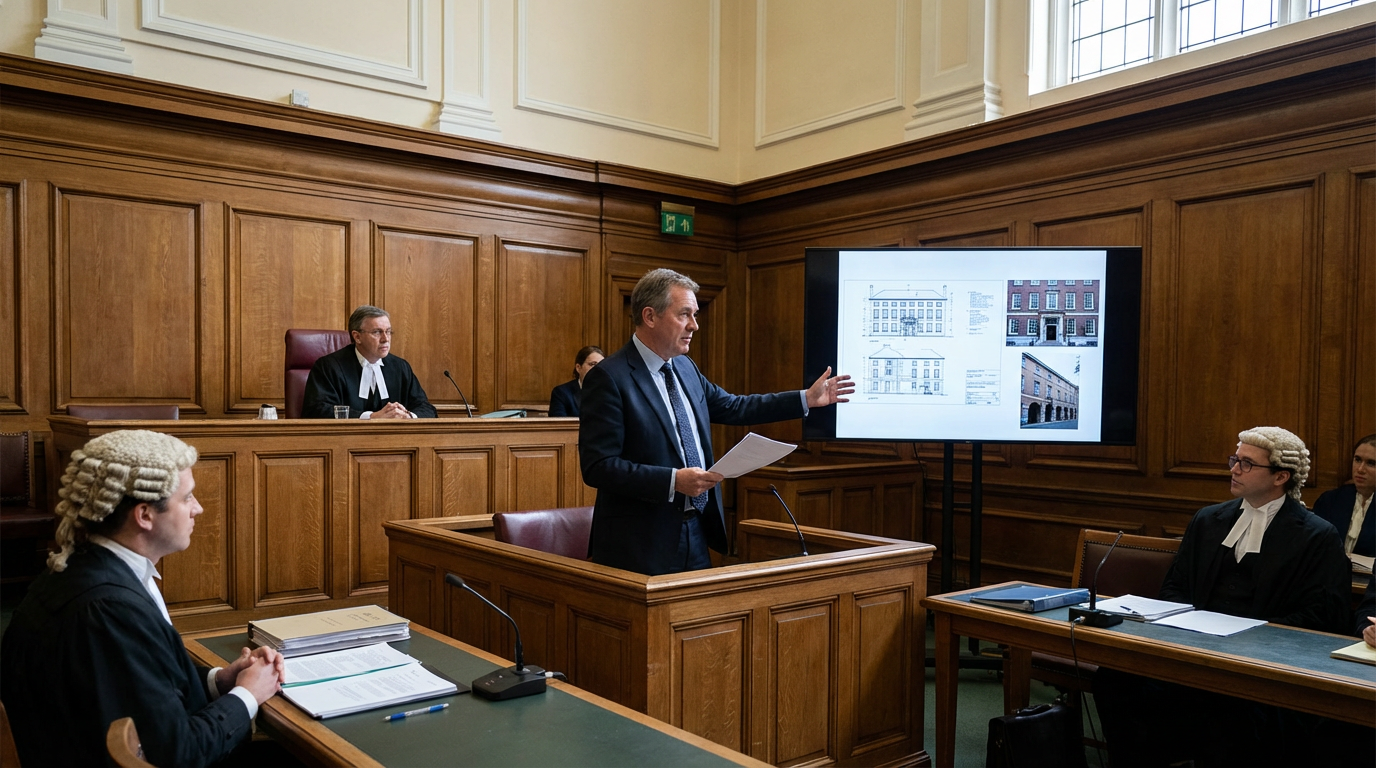
Property disputes are remarkably common — and when they reach the courts or tribunals, the outcome often hinges on the quality of expert witness evidence. A well-prepared, clearly argued expert report from a credible surveyor can be the difference between winning and losing a case. A poorly prepared one — written by a surveyor who misunderstands their role — can damage a case irreparably.
I have acted as an expert witness in property disputes for over 15 years. In this article, I want to explain exactly what expert witness surveyors do, what makes a good expert report and when you should instruct one.
What Is an Expert Witness Surveyor?
An expert witness is someone with specialist knowledge who is instructed by a party (or the court) to provide impartial technical opinion on matters in dispute. In property cases, the expert is typically a building surveyor or structural engineer whose expertise is relevant to the specific issue — building defects, property values, dilapidations, party wall damage and so on.
The key distinction between an expert witness and an ordinary witness is that an expert is permitted to give opinions rather than just facts. A lay witness can only tell the court what they personally saw, heard or did. An expert can say "in my professional opinion, the cause of this cracking is subsidence resulting from the removal of tree X in 2019 — and here is my reasoning."
The Expert's Duty: To the Court, Not the Client
This is the most important aspect of expert witness work to understand. Under CPR Part 35 (the Civil Procedure Rules that govern expert evidence in English courts), an expert's primary duty is to the court — not to the party that has instructed them. This means that a good expert must give their honest professional opinion regardless of whether it helps or hinders the case of the party instructing them.
Courts are sophisticated enough to identify experts who are simply advocating for their clients rather than providing independent opinion. Such "hired gun" experts damage the cases they're supposed to be supporting. True independence — the willingness to say things your client doesn't want to hear — is what makes expert evidence credible.
In practice, this means that before I accept an instruction, I carry out a preliminary review of the facts to ensure I can provide an honest, supportable opinion. If the case doesn't support the position the instructing solicitor needs, I'll say so clearly and decline the instruction rather than produce a misleading report.
Types of Property Disputes Requiring Expert Surveyors
Dilapidations Claims
When a commercial lease expires or is forfeited, landlords often serve a dilapidations schedule claiming the cost of putting the property back into the condition required by the lease covenants. Tenants frequently dispute the quantum or the reasonableness of the claim. Both parties instruct surveying experts to support their positions, and the joint statement of the experts (where they've attempted to narrow the issues in dispute) is often central to how the case is resolved.
Construction Defect Claims
When building works have gone wrong — structural failures, waterproofing defects, specification failures, poor workmanship — the affected party needs expert evidence to establish the nature and extent of the defect, causation, and the reasonable cost of remediation. My construction project management background makes me particularly well-placed to assess the reasonableness of contractor pricing in these disputes.
Boundary and Party Wall Disputes
Boundary and party wall disputes are among the most acrimonious in property law. Where parties cannot agree on the position of a boundary or the cause and extent of damage from party wall works, expert surveyors are instructed to provide objective technical analysis. I have experience before the First-tier Property Tribunal (formerly the Lands Tribunal) as well as in the County Court.
Subsidence and Insurance Disputes
Insurance disputes following subsidence claims frequently require expert evidence on the cause of movement, the relationship between a claimed trigger event (such as a tree removal or drainage failure) and the damage observed, and the reasonableness of proposed remediation schemes.
Professional Negligence Claims
When a buyer or client claims that a previous surveyor was negligent in failing to identify a defect or advise correctly, an expert surveyor is instructed to provide an opinion on whether the defendant surveyor's conduct fell below the standard of a competent practitioner in the field. These are complex cases that require careful analysis of what was or wasn't visible at the time of the original inspection.
What Makes a Good Expert Witness Report?
After reviewing many expert reports — both as an expert myself and in my capacity discussing findings with legal teams — I've come to believe that the best expert reports share certain qualities:
- Clear structure: The report should flow logically from instructions to factual background, to technical analysis, to conclusions and opinions. The court should be able to follow the reasoning without specialist knowledge.
- Authoritative but balanced: The expert should express their opinion with appropriate confidence while acknowledging limitations and alternative explanations where they genuinely exist.
- Well-evidenced: Every opinion should be supported by factual observations, measurements, photographs or technical references. Assertions without evidence are worthless in court.
- Compliant with CPR Part 35: The report must include all required statements — the expert's declaration, a summary of instructions, a confirmation that the expert understands their duty to the court and a statement of the limits of the expert's expertise.
For more about our expert witness services, see our expert witness page.